Particle attraction
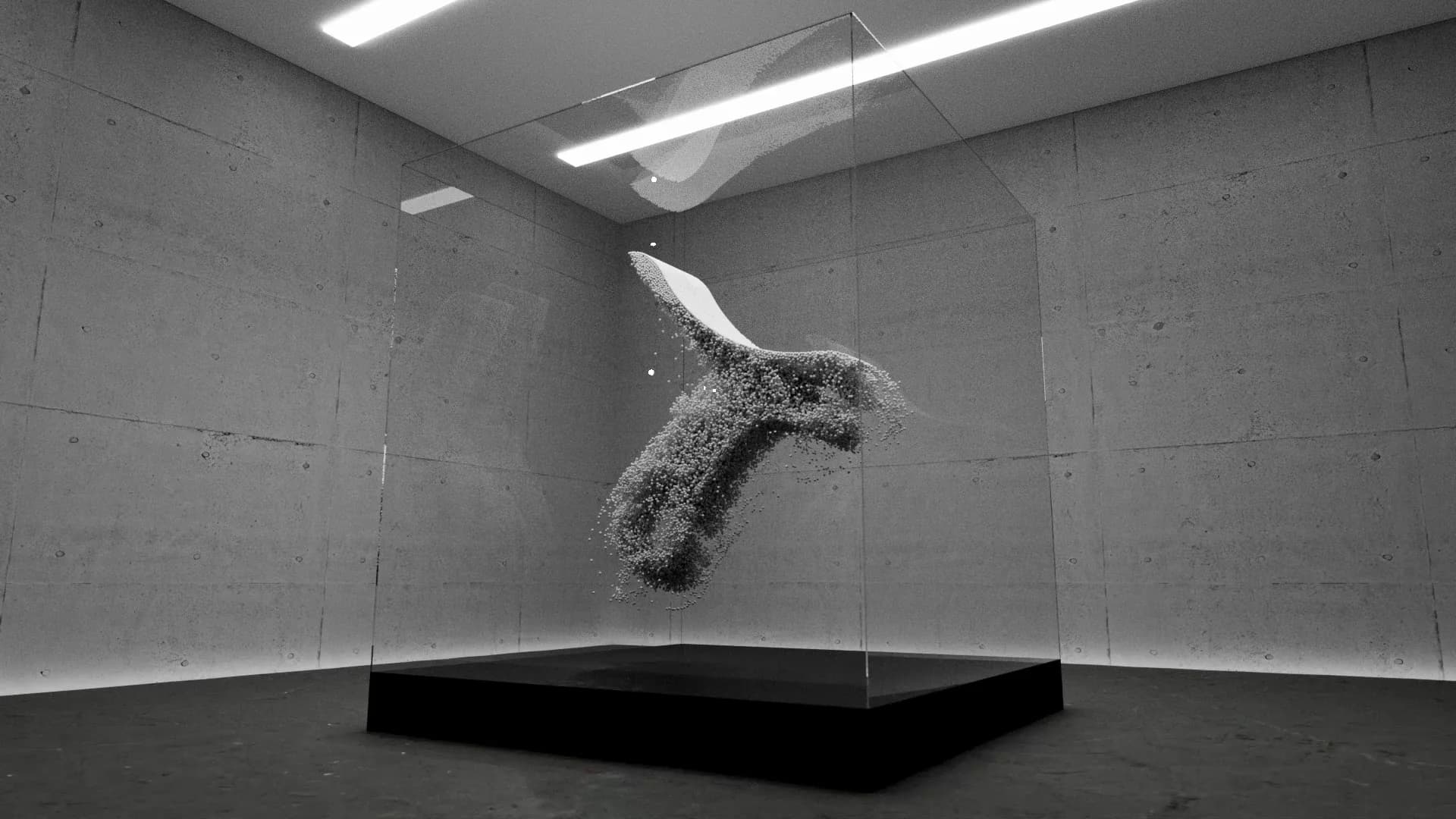
A challenge from a colleague
This began at Intrepid Creative, following the particle work on Visa's Analytics Platform. Tim Kwong wanted to push the same techniques somewhere less commercial, as an ode to Maxim Zhestkov's installations.
The real question was not the look. It was whether Blender could stand where Houdini usually does — Houdini being the tool most people reach for the moment a shot involves serious particle work. So the constraint was that everything had to be achieved in Blender, including the parts it is not known for.
What "stickiness" means to a solver
Most particle systems ship with a handful of baseline behaviours: gaseous, liquid, flame. Those are useful and they are also a small corner of what particles can do, because each one bakes in assumptions about how a particle relates to its neighbours.
This study is non-Newtonian — meaning the material does not behave with a fixed viscosity. Think of cornstarch and water: it flows when left alone and resists when struck. What makes a material behave that way is not a property of any single particle, but of how strongly particles hold on to each other, and how that grip changes with what is happening around them.
In this system each particle attracts its neighbours within a certain pocket distance. Inside that radius, particles pull together. Outside it, they ignore each other entirely.
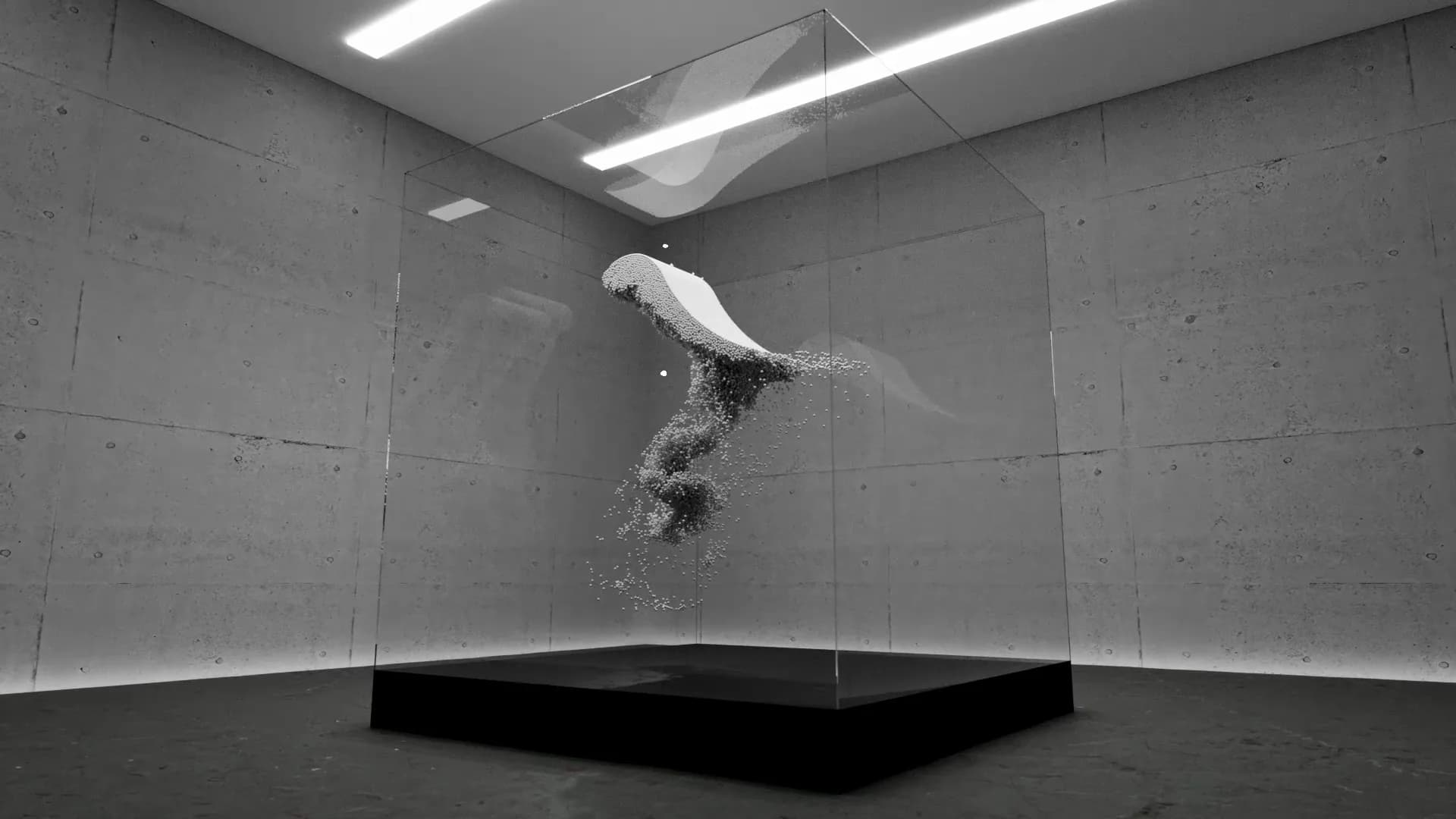
That single rule is what produces the clumping in these stills. Nobody modelled a clump. The clumps are emergent — they are what a field of particles does when you tell each one to hold on to whatever is close enough. Widen the pocket distance and the mass becomes a single sluggish body; narrow it and it disperses into dust. Everything between those two extremes is the useful range, and finding it is most of the work.
The force field, and why the shape holds
Attraction alone gives you clumps drifting nowhere. The motion is driven separately, by a force field that guides the whole mass around the bounding shape of the Intrepid Creative logo.
This is the part worth taking away. There are two systems running at once and they are deliberately independent: attraction governs how particles relate to each other, and the field governs where they all go. Keeping them separate is what makes the result directable — the silhouette can be changed without touching the material, and the material can be made stickier or looser without losing the shape.
Collapse the two into one and you get a simulation that has to be re-tuned from scratch every time the art direction moves.